July 26, 2026 — By Hardi Huang
Today, Julia and I went to see the immersive theatre production The Deal. It left a deep impression on me and connected closely with many things I have been learning and reflecting on recently.
The protagonist, Marcel, is an insignificant man looked down upon by society. In the eyes of others, his life appears to be a failure: he has achieved little at work, lacks the courage to pursue love, and lives a dull and repressed existence.
In a dream, he briefly catches sight of the happy life he longs for. But when he wakes up, he must return to a reality in which he remains unseen and unrecognized.
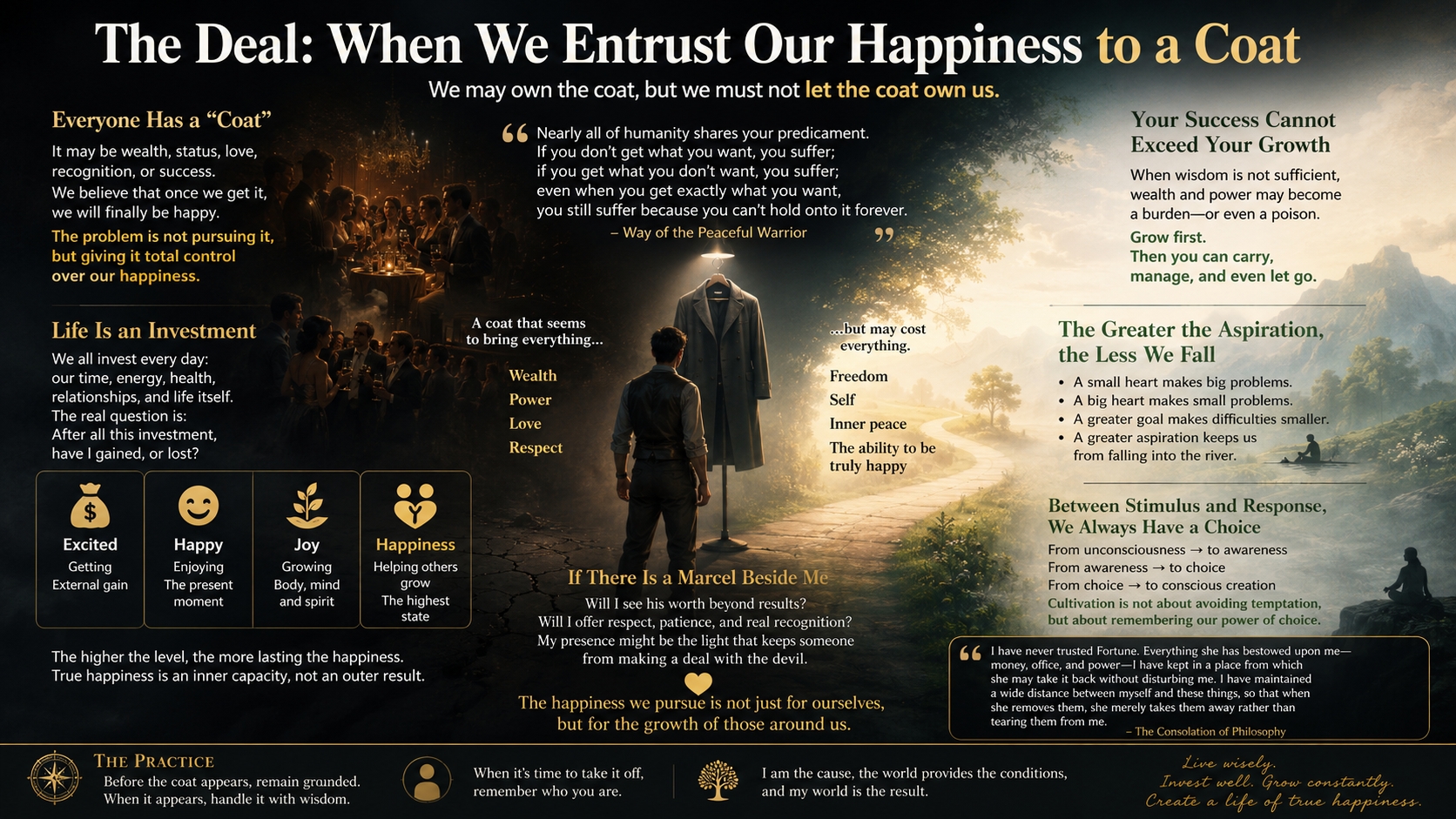
And so, he places his identity, dignity, and hopes for the future in a single coat.
He believes that once he owns the coat, he will also possess wealth, status, love, and the respect of others. If only he can become someone other people admire, he thinks, then he will finally be happy.
Yet despite all his hard work, his chances of obtaining the coat remain painfully slim. After a long inner struggle, desire finally overcomes reason. Marcel makes a deal with the devil, exchanging his soul for the fulfilment of his desires.
For a brief moment, he appears to have everything.
In the end, however, he is left with nothing.
As I watched Marcel, one question kept returning to me:
Is that coat really so far removed from our own lives?
Everyone May Have a “Coat” in Their Heart
The coat Marcel pursues resembles the ideal life many of us imagine for ourselves.
It may take the form of wealth, status, a house, fame, professional success, or the love and recognition of another person.
We often tell ourselves:
Once I earn enough money, I will finally feel secure.
Once I succeed, I will become confident.
Once others recognize me, I will have proven my worth.
Once I possess certain things, I will finally be happy.
The problem is not that we should not pursue these things. The real question is whether we have handed them complete authority over our happiness.
The moment I decide, “Without this coat, my life can never be happy,” the coat is no longer simply a goal. Gradually, it becomes my master.
I think I possess it, when in reality it is controlling my emotions, my choices, and the direction of my life.
Cultivation does not mean abandoning our longing for a better life. It means gradually seeing more clearly:
I may pursue outward success, but I must not mortgage all of my inner happiness to it.
Life Requires Investment — What Makes It a Good Deal?
In our studies, I encountered a perspective that left a strong impression on me. In business, there is a Chinese term, benqian, meaning both capital and the principal one begins with.
One part is the “money”: wealth, possessions, positions, and all the external resources that can be measured.
The other part is the “principal”: health, joy, happiness, growth, dignity, and the overall quality of one’s life.
Money has a price.
But this deeper form of capital is priceless.
Whether we realize it or not, life always requires investment.
Every day, we invest our time, our life, our body, our health, our emotions, and our energy. So the most important question is not simply:
“How much money have I earned?”
It is:
After investing so much of myself, have I truly gained, or have I suffered a loss?
Some people appear to make a great deal of money, yet lose their health, their relationships, and their ability to experience happiness. They have earned money while losing their principal.
Others may earn less in the short term, yet gain ability, experience, growth, and a clearer sense of direction. They may lose money temporarily while strengthening the deeper capital of their lives.
The ideal state is to create external value without losing one’s inner vitality—to earn money while also enriching one’s life.
On the surface, Marcel appears to make an extraordinarily profitable deal.
He exchanges an invisible soul for visible wealth, power, and love. But from the perspective of long-term return on investment, it is a complete loss.
He gains the coat, but loses his freedom.
He gains the attention of others, but loses himself.
He gains a brief period of celebration, but loses the ability to experience genuine happiness.
It is not that he earns nothing.
It is that he loses all of his true capital.
This also leads me to reflect on my own life:
Are the things into which I invest my time and energy making me more whole, or are they merely making me appear more successful?
What Kind of Happiness Are We Really Pursuing?
We often understand happiness as “getting what we want.”
But when we look more carefully, the feeling of obtaining something may be no more than satisfaction. Enjoying a pleasant moment may be pleasure. Seeing ourselves improve may bring fulfilment. The deeper joy that comes through continuous growth is something more enduring.
In our studies, we once distinguished several levels of positive experience:
Satisfaction comes from obtaining something; it is the pleasure of an external gain.
Enjoyment comes from fully experiencing the present moment.
Joy comes from growth, from sensing that life is moving upward.
Deep gladness comes from the integrated growth of body, mind, and spirit.
And a higher form of happiness arises when our existence also helps others to grow.
After Marcel obtains the coat, he certainly experiences satisfaction and pleasure.
He attends banquets, enjoys wealth, receives attention, and finds that those who once ignored him now gather around him.
But this happiness cannot last, because it depends entirely on the coat.
While he has it, he fears losing it.
Once he loses it, he also loses the source of his happiness.
There is a line in Way of the Peaceful Warrior:
“Nearly all of humanity shares your predicament. If you don’t get what you want, you suffer; if you get what you don’t want, you suffer; even when you get exactly what you want, you still suffer because you can’t hold onto it forever.”
Happiness obtained through material exchange is often fleeting.
True happiness is not an external result, but an inner capacity and a form of wisdom that must be cultivated.
Confucius praised his disciple Yan Hui with these words:
“With a single basket of rice and a single gourd of water, living in a poor alley—others could not endure such hardship, yet Hui did not allow it to diminish his joy.”
Yan Hui’s happiness did not come from possessing more than others. It came from refusing to surrender his capacity for happiness entirely to his external circumstances.
I may own the coat, but I must not depend on it in order to be happy.
I may pursue success, but I must not tell myself that I deserve happiness only after I have succeeded.
Your Success Cannot Exceed Your Growth
There is another saying from our studies:
“If the body grows but wisdom does not, one struggles through life. If both body and wisdom grow, one can live with freedom and ease.”
The same conditions, the same wealth, and the same opportunities can produce completely different results in the hands of different people.
When a person lacks the wisdom and maturity to handle wealth, power, and fame, these things do not necessarily bring freedom. Instead, they may turn against the person who possesses them.
Someone who suddenly wins the lottery but has never developed the ability to manage wealth may quickly lose everything.
Someone with extraordinary skills but insufficient maturity may also be harmed by their own abilities.
Like Sun Wukong, the Monkey King, such a person may eventually find himself trapped beneath a Five-Finger Mountain created from his own greed, desire, and inner poisons.
The underlying principle is this:
Our success cannot exceed our growth.
Otherwise, when our character is not equal to our position, misfortune will eventually follow.
Marcel does not fail simply because he possesses the coat.
He fails because he has not yet grown into someone capable of carrying it.
Before receiving the coat, he longs for recognition.
After receiving it, he still needs even more recognition to prove his worth.
His external identity changes, but his inner sense of lack remains untouched.
If a person has not learned to accept himself, possessing more will only make him more afraid of loss.
If a person has not built an inner sense of worth, a higher position will only make him more dependent on the gaze of others.
True cultivation is not merely about obtaining what we want.
It is about growing into someone who can carry it, manage it, and, if necessary, let it go without losing himself.
The Greater the Aspiration, the Less Easily We Fall into the River
I also kept wondering why Marcel was so easily captivated by a single coat.
Perhaps his world had become too small.
When a person’s life is reduced to:
“I must prove myself,”
“I must make others respect me,”
or
“I must win this person’s love,”
then every failure feels overwhelming.
Several lines from our studies have stayed with me:
When the goal is greater, the difficulty becomes smaller.
When the aspiration is greater, we are less likely to fall into the river.
When the heart is small, the problem becomes large.
When the heart is spacious, the problem becomes small.
Here, a “greater goal” does not mean earning more money or achieving a higher social position.
It means allowing one’s life to carry greater meaning.
If Marcel’s aspiration had not merely been to prove himself, win Natalie, or make others envy him, but instead to create value through his abilities, help others, and allow the people around him to grow, would the coat still have held such power over him?
When life revolves only around the self, a single rejection can crush us, and a single failure can send us “into the river”—into emotional reactivity, resentment, and confusion.
But when my vision no longer rests only on myself, when I know that I carry greater responsibilities, a longer-term direction, and people or principles I genuinely wish to protect, then the coat in front of me can no longer become my entire life.
Aspiration is not something we use to make ourselves appear grand.
It helps us see farther when facing temptation, gain and loss, and frustration.
Choosing Again Between Stimulus and Response
If another person lived under the same conditions as Marcel, could that person make a different choice and live a different life?
I believe the answer is yes.
Viktor Frankl discovered in the Nazi concentration camps that although human beings cannot always control their circumstances, they retain the freedom to choose their attitude toward those circumstances.
Marcel faces poverty, failure, contempt, and temptation.
These are the external stimuli imposed upon him.
But between stimulus and response, there is always a space.
Within that space, a person may be unconsciously driven by habit and desire, or may first become aware of his thoughts and then choose again.
We learned a very clear progression:
From unconsciousness to awareness.
From awareness to choice.
From choice to active creation.
Marcel’s tragedy is not that he never had a choice.
It is that, through repeated frustration and temptation, he gradually forgot that he still had one.
This also turns my attention back toward myself.
When society repeatedly tells me what success is supposed to look like, and when everyone around me is pursuing the same coat, can I remain grounded even if I began with clarity?
Will I mistake anxiety for ambition?
Will I call comparison the pursuit of excellence?
Will I describe an uncontrollable desire for more as responsibility toward my life?
True cultivation does not mean guaranteeing that I will never be tempted.
It means seeing desire earlier when it arises.
And when I have already “fallen into the river,” it means refusing to sink deeper and knowing how to return to the shore.
What If There Is a Marcel Beside Me?
The most ingenious part of the production is that we are not passive spectators seated at a safe distance.
We participate in the work, the transactions, the gambling, and the celebration.
We also help create the worship surrounding the coat.
We are not merely standing outside the story, criticizing Marcel.
We are part of the value system that shapes him. We participate in generating desire and creating the atmosphere of collective excitement.
For this reason, The Deal is not only examining Marcel.
It is examining every member of the audience.
If there were a Marcel beside me, how would I influence him?
When someone is experiencing failure and self-doubt, would I continue to judge him by wealth, position, grades, and visible results?
Or would I be willing to see the value of the human being himself?
When a child, a colleague, or a friend has not yet achieved visible results, am I willing to offer respect, patience, and sincere recognition?
Perhaps the devil succeeds not only because desire exists within Marcel, but also because too few people in his world truly saw him before he put on the coat.
If the happiness we pursue means only obtaining more for ourselves, then it may still remain at the level of satisfaction and pleasure.
A more lasting happiness may arise when, through our own growth, the people around us also gain a little more confidence, hope, and opportunity to grow.
I May Own the Coat, but I Must Not Let the Coat Own Me
After seeing this production, I increasingly feel that the real cultivation is not about obtaining the coat more quickly.
It is about this:
Before the coat appears, can I remain grounded within myself?
When the coat appears, do I have the wisdom to handle it?
And when the day comes that I must take it off, do I still know who I am?
We once learned:
I am the cause, the world provides the conditions, and my world is the result.
A passive life treats the external world as the cause and one’s emotions and destiny as the result.
An active life begins from within and chooses how to interpret, how to respond, and how to create.
This is also why the classical Chinese saying—
“When your actions do not bring the desired result, look within yourself”
—does not mean blaming yourself for everything.
It means that when the external environment lies beyond your control, you are still willing to return to what remains within your influence and ask:
What wiser choice can I still make at this moment?
If I were Marcel, I cannot promise that I would never be tempted.
But I hope that before signing the contract, I would pause and ask myself:
What do I truly want—the coat, or dignity?
Wealth, or security?
The envy of others, or inner peace?
To be chosen by someone else, or finally to accept myself?
Is this investment of my life truly profitable, or am I losing the very foundation of who I am?
Life inevitably involves transactions.
But some things must never be traded.
We must not exchange life for success.
We must not exchange inner freedom for the gaze of others.
And we must not entrust our capacity for happiness to a coat that may be taken away at any moment.
There is a passage from The Consolation of Philosophy that I deeply appreciate:
“I have never trusted Fortune. Everything she has bestowed upon me—money, office, and power—I have kept in a place from which she may take it back without disturbing me. I have maintained a wide distance between myself and these things, so that when she removes them, she merely takes them away rather than tearing them from me.”
True happiness is not finally acquiring a certain kind of life.
It is preserving the ability to remain the master of my own life, no matter where life takes me.
📖 Further Reading
- 聚焦错觉:被放大了的幸福与痛苦
- https://mp.weixin.qq.com/s?__biz=MzI3Mjc5NzcxMQ==&mid=2247497233&idx=1&sn=700c624a2c1eb11c30aef6dbd5c71715&chksm=eb2faf71dc58266729772efebef41815f866d1b9d5a229fcc12e6800ebea1f2d34135bf6dfe2
- 生命中的核桃
- https://mp.weixin.qq.com/s?__biz=MzI3Mjc5NzcxMQ==&mid=2247492370&idx=1&sn=bcfe79603fbf897942a7989c7871a2e3&chksm=eb2fba72dc583364778cf36a66eb96c04f66089cf25d18ce77594bcbbcd04e64729c4a4e6fb2